


Case stories on dialogic interventions
Dialogue after arson
Situation
Jacob Loisplein in Rotterdam is a busy square in a densely populated, multi-ethnical working-class neighborhood. The 1920s square, with its trees, seating areas, and artificial turf football field, became a vibrant social hub. However, noise complaints arose as football and youngsters' conversations continued late into the night, leading to tensions between residents. Eventually, an unknown individual set fire to the football field. In response, the local social team closed the adjacent community center, further deepening divisions. The conflict escalated. The ’city marine’, an official responsible for dealing with incidents, directly reporting to the mayor, heard of the crisis, secured funding, and invited us to facilitate an intervention.
Three-stage approach:
For these interventions, we use a three-stage approach: First, dialogues with the separate groups, also to get them acquainted with the non-violent character of a dialogic intervention. Followed by a plenary session, ‘the whole system in the room’; i.e., next to both sides, also city officials, police, and social workers are present.
Preparation
In this kind of intervention, I was the lead facilitator of our team. First, I met with the city marine and alderman, who pledged a small budget for improvements if the process succeeded.
We then coordinated with the social team and police, briefing them on the dialogue approach and inviting the youth workers involved to join an on-the-job training in dialogue facilitation during the entire process. Introduced by a youth worker, I approached the young people on the square one evening, listening to their frustrations and gaining trust. Gradually, some saw it offered an opportunity to have a voice in the improvement of their neighborhood. They appreciated that the city was willing to listen, but showed not so comfortable in being confronted with the other, the older residents. Secondly, we did a door-to-door round, talking to the older residents. Initially, they were fearful, but the assurance that they would first speak only among themselves convinced a small group to participate.
Dialogue with the Youth
On the agreed evening, a group of about 20 youngsters had gathered outside the community center. They were curious but restless and hesitant. Only five chose to come in and join a circle dialogue. As we engaged in open conversation, their peers outside grew restless and tried to draw their attention, but without success. Eventually, they all came in and joined us. Even a strong-built man of Moroccan descent, ‘Khalid’, in his mid-twenties, clearly their informal leader, showed up. From my teacher, I learned to greet and acknowledge such a leader and not to let go of his hand until I felt I had established contact. A key moment to gain his respect and trust. With him involved, the others followed. The easing dialogue process slowed them down, and to their surprise, they discovered how many different perspectives and opinions thrived even within their group. Quieter, more thoughtful members found their voice and gained respect. One could witness a social reset for the better. The group gained trust in the dialogue, recognized the need for good agreements, and began generating ideas for the square.
Dialogue with the Older Residents
About 15 older residents attended, initially apprehensive about being labeled as "opponents." They spoke nostalgically about how the neighborhood had changed, but as the discussion progressed, they recognized the positive aspects of the present, including its liveliness and sense of community. A realization emerged that with clear agreements, the square could become enjoyable for everyone. Buoyed by the structured dialogue, they agreed to participate in the larger discussion and bring their neighbours. The positive word had started spreading!
Interim Report to Alderman, Police, and District Team.
We had a meeting with our partners to discuss the progress. The signs were positive and hopeful. The alderman agreed to attend the plenary evening and had a small budget ready to make commitments on the spot. Two youth workers wanted to train as dialogue facilitators, with our team's support.
Joint Dialogue
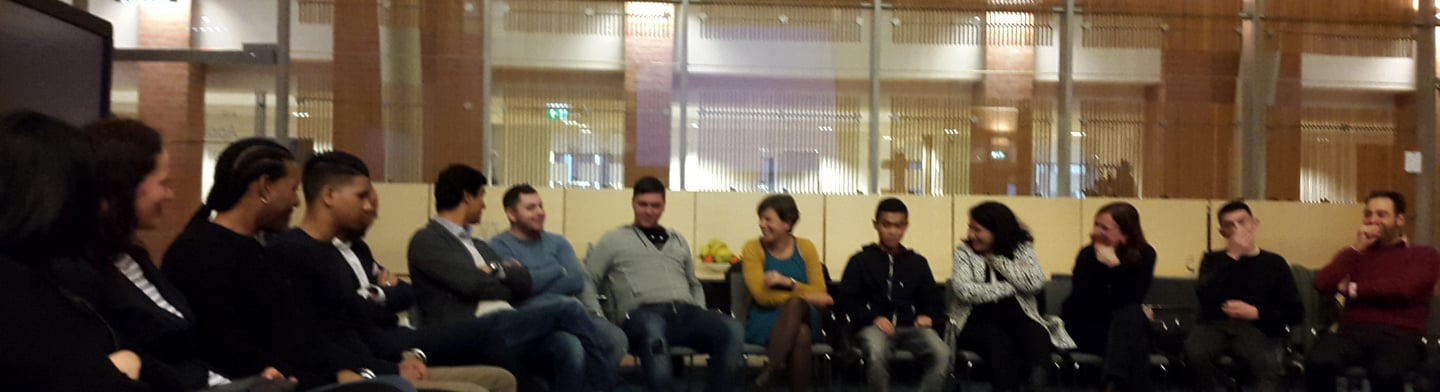
The final meeting brought together about 60 people: 25 younger and 20 older residents, social workers, local police, a supermarket owner, the alderman, the city marine, and our facilitation team. We started in a large circle to instigate the sense of community, with everyone’s voice briefly heard. Then, everyone was mixed up in smaller circles, facilitated by us. The youth workers joined as trainees. In dialogue, participants started to listen and connect, and trust increased. Respect for each other’s perspectives and experiences grew. Groups explored deeper questions and envisioned social agreements and improvements. Each circle documented its findings on a brown paper. The atmosphere was connecting and uplifting.
During the break, Khalid stood apart with some peers, talking agitatedly in Berber, dissonating from the general mood. I approached him. Our relationship made it possible for me to ask why he was so emotional. He shared sceptically and desperate that all of this would lead to nothing. He felt that the police would never treat him fairly. He confided that past mistakes haunted him, as officers routinely targeted him without reason, costing him jobs and opportunities. I challenged him: if he wanted real change, he had to voice this to the police, later in the plenary circle. In front of his peers, he accepted the challenge.
In the final plenary session, all groups shared their outcomes, which we could consolidate into two documents: one outlining ideas for the square and another detailing a new social behavioural contract. The alderman was pleased with the result and the atmosphere and pledged funding for the restoration of the square and the public display of these agreements.
Before the closure, I handed the talking stick to Khalid. He tried to address the neighbourhood’s police officer, but before he could speak, another officer, ‘coincidentally’ sitting next to him, put a hand on his shoulder and attempted to silence him, afraid of a confrontation. Khalid showed himself angry and powerless by this acknowledgment of the prejudice. I assured the officer that Khalid would speak in dialogue, from the heart. Khalid grabbed himself together, acknowledged his past, and pleaded for a fair chance. His emotional words resonated deeply. A group of younger boys sitting opposite him watched in awe as their leader broke down, prompting him to turn to them and say, "Yes, don't do what I did - it leads nowhere." As silence fell, a tiny elderly black woman rose from her seat and applauded, triggering a standing ovation from the entire community. Khalid and the police were seen aligned with the new intentions.
Results
The football field was restored, the square improved, and as far as we know, the agreements have held. New appointments were made between Khalid and the police, including direct communication to prevent future escalations. Dialogue transformed conflict into connection, proving that real change starts with conversation.
A dialogue between Police and Youth
Situation
In Delfshaven, an old pre-war working-class district of Rotterdam, tensions between police and street youth had escalated into a cycle of provocation, violence, and mistrust. Young men — mostly with Moroccan, Antillean, and Surinamese backgrounds — felt continuously hunted and humiliated; officers felt disrespected and unsafe. Since we successfully had facilitated dialogues in other neighbourhoods, the local superintendent asked us, our foundation to facilitate a nonviolent dialogue to break this pattern.
Approach
Together with the local superintendent, youth workers, and social services, we set up a four-step dialogue process: first with police officers, then with the youth, followed by a joint dialogue and a follow-up session.
The police initially doubted the need for an internal dialogue. We persisted and it proved essential. In a circle of 25 uniformed officers, at guard at first, gradually openness and vulnerability surfaced— about exhaustion, fear, and the distance from the ideals that once drew them to the job. Some tears came along. The session ended with renewed openness and readiness to meet the young people.
The youths, gathered through trusted youth workers, showed a similar pattern — cynicism melting into honesty. Beneath anger and pride lay a wish to be seen. The circle gave space to quieter and more reflective voices, shifting the group’s tone and maturity. An insight grew about the potential gains if they could get beyond the current cat-and-mouse behaviour.
The Joint Dialogue
Fifty people gathered in the community center: 25 officers, 25 young men and women. At first, they sat opposite each other in the circle, silent and tense. After the opening I invited them jokish to blend. In the break out circles, one by one, stories emerged. Initially the officers kept a distantiated posture, denied ethnic profiling. Even after hearing heartbreaking stories of youngsters being stopped and searched daily on the way to work. This created a huge build-up of tension. The youngsters were about to leave en masse. I confronted the officers with a story of my own, white, daughter, who attended a school in the same neighbourhood. She had never been asked for her ID. Then one officer broke, finally admitted that ethnic profiling did happen and shared his discomfort with it. The atmosphere shifted. Relief.— He and his colleagues started sharing about the fear in their families, when going on a nightshift, of children waiting at home, and how much they disliked having to be in such a relation with the youth. They appologised for keeping up their posture.
A young man laughed: “So you’re just like us — a gang that has to stick together.” The room erupted in laughter and recognition. From that moment, the conversation turned toward solutions: greeting and meeting more often, reducing armed patrols, building personal contact, and involving parents in keeping trust alive.
Results
Relations improved visibly. Youths and officers began greeting each other on the street. A representation of youngsters and officers agreed to meet on a regular basis. To prevent and solve hick-ups. This improved contact lasted for many years. Nowadays it has eroded, tensions resurfaced, new officers and new youngsters. — a reminder that trust needs maintenance.
Dialogue Two Days After a Fatal Shooting
Situation and Background
Hoogvliet is a suburb of Rotterdam — a relatively new, multi-ethnic working-class town. It was regularly in the news due to gang-related violence. An Antillean woman, Arlene, tried to make a difference by running a “Chill-house” in an anti-squat building — a place where young people could gather instead of wandering the streets. I knew her because she had once invited me to facilitate a dialogue there. She led the youth center together with her partner, Djodjo, a former inmate who had turned his life around and held a lot of respect among the youngsters. A few months later, she called me. That very day, a 20-year-old boy had been shot dead by someone from a rival youth gang. She, the police, and social workers feared escalation. Arlene asked if I could facilitate a de-escalating dialogue.
Preparation
I accepted. But I was scared. I Skyped with my teacher, the Native Chief Phil Lane Jr. in Vancouver, who had taught me the dialogue method, and asked him: “What should I do? The whole neighbourhood is shaking all over.”
Phil answered with a smile that this was exactly what they should be doing — shaking — as part of processing a trauma. We prepared the evening together. In that he predicted that “the real heavy guys” would always enter last, and with a laugh he urged me to end the evening with shaking and a joke.
I also realised that, facing these male youth gangs, I needed a woman next to me — not to fall into a macho-versus-macho dynamic. I asked Karin, one of my foundation colleagues, to step in with me, and I was relieved when she agreed.
In our preparations, Arlene and Djodjo promised to call in both groups and they would be present themselves.
Many involved seemed angry and full of accusations and questions for the police and the youth worker. Therefore, both would attend the first half of the evening to answer questions. The police also wanted to position an intervention team nearby. I asked them to keep their distance at the start.
The Dialogue Evening
The street outside the youth centre in Hoogvliet was crowded. Groups of youngsters lingered around, collectively hesitating to go inside. With help of Arlene and Djodjo we got the group moving. At a distance, I saw several large men hanging around a big American car — clearly leaders. I asked Djodjo to walk over with me to strike up a conversation. After a short chat they indicated they would be willing to join the dialogue.
First Half – Questions to the Police
We opened the evening with a welcome, explained the principles of dialogue, creating structure and ease with the passing of the stick, and outlined the program proposal:
Before the break: questions to police and youth work.
After the break: a dialogue among each other, without police.
It was accepted.
We began with about 35 people in the room, two-thirds men, one-third women.
Karin, the police officers, and I were the only white people present — a tense setting.
The dialogue format brought calm and safety, preventing emotional escalation. We ensured the police received good questions and the people received clear answers. Then, about 30 minutes in, the door opened, and a group of ten men entered — several huge Antillean bodybuilders, who landed leaning against the wall.
Just as Phil had briefed me, I walked straight up to the obvious leader, shook his hand, and didn’t let go until I felt sincere contact. He introduced the younger brother of the slain boy, standing beside him, and said they “wanted to just observe and check this out.”
I welcomed them, told them we were making good progress — confirmed by the circle — and explained the principle: “You’re here and you participate, or you’re not here at all. ” Precisely for safety and confidentiality.
After a brief glance, he signaled the others to join. I handed him the talking stick so he could pose a question to the police.
The atmosphere toward the police and the youth worker softened along the way. After coffee they left on good terms.
Second Half – Dialogue Among the Community
After the break we continued in two smaller, mixed circles, to talk about what had happened and what it had done to each person.
In my circle were two massive bodybuilders sitting next to each other, a mother with her 10-year-old son, several teenage boys, a rapper, and a number of young women.
One of the giants spoke first — angry, aggressive — saying he was mad at the boy who had been shot: ¨He should have fired first.”
He passed the talking stick to the 10-year-old sitting next to him, who was completely shocked and passed it on immediately. The youngsters were deeply affected. Three of them had seen the shooting happen right in front of their eyes.
I asked the big angry man what example he wanted to be, pointing to the 10-year-old, telling him the boy would also end up “in the hood” if this continued.
The mother, who had supported the bodybuilder in his anger, emotionally denied it. I gently confronted her with her own words.
Then one of the three eyewitnesses stood up and ran crying to the toilet. The other two followed.
One returned and told me the first boy didn’t want to come out anymore and was crying nonstop.
I followed him to the toilets. We stood there together. They held each other — and me. They asked if they could leave.
“Of course,” I said. “Everyone is here out of free will. But take care of each other.”
“How?” they asked.
“Take a stick or a stone at home, pass it around. Listen to each other, talk about what you feel. Dare to cry. And don’t forget to shake — it helps.”
Then I started shaking. The four of us shook together in the toilet. A relief.
They began laughing through their tears. With a strangely formal “thank you, sir,” they went outside.
Back in the circle we continued.
A young woman opened by saying she felt desperate in this circle, because “it made her feel like this could all happen again tomorrow.”
She addressed the two Antillean bodybuilders directly: “As long as we keep having this macho stuff, we are not safe in our own neighbourhood — and we end up in the newspaper every month as Rotterdam’s drain!” Silence followed.
One of the bodybuilders grabbed at his eyes, hiding his tears, stood up, and hurried to the door.
The other, legs shaking, eyes wide open, received the talking stick. “I know this is how I react when something terrible happens, I’ve taught myself to be hard. Otherwise, I’ll break.” He began to sob deeply and continued: “When I was five years old, I lived in a flat here in Hoogvliet. There was a sandbox in the courtyard. One morning, when I opened the lid, there was a severed head lying in the sand. From then on, I learned to be hard.” He cried uncontrollably and passed the stick. We all sat in silence with him as he cried.
The stick reached the rapper, who broke the silence and said: “Yo man… respect. Now you’re an example for him,” nodding at the 10-year-old.
We stood up in a group hug.
Closing
Finally, we brought the two circles together and stood in one large circle. I asked everyone to hold hands. Then I invited them to shake, starting with myself. A beautiful, big black woman across the circle laughed in a humorous Antillean accent:
“Do we now have to learn how to shake from a white man?” Laughter and relief washed through the room.
Finally I turned to the rapper and asked: “What’s the dumbest joke you know?”
He hesitated, then asked the group: “Why is a firefighter buried behind the church?” Laughter, “How should we know?”
“Because that’s where the graveyard is, jo,” he answered in his sleazy street slang.
The whole group walked out of the building roaring with laughter.
Outside, four police intervention vans stood waiting, officers in bulletproof vests. I walked up to them.
The chief shook my hand and said: “I believe we won’t be needed tonight.”
Tensions around a shopping center
Situation
Keizerswaard is a shopping center in the south of Rotterdam, located in a lively and multicultural neighborhood. On the square in front of the entrance, groups of young people with Moroccan, Surinamese, Turkish, and Antillean backgrounds gathered daily.
Their presence was perceived by many older, mostly white residents as intimidating. This led to tensions and complaints about nuisance. The local social team asked us to help improve the relationships between the groups.
Approach
Together with the social team, we chose a dialogue-based process — first in separate groups, then together. We agreed that youth workers and social workers would participate and, through a train-the-trainer approach, would learn the method from the inside.
During the separate dialogue evenings, both the young people and the elderly shared their experiences:
The youngsters explained that they felt stigmatized.
The older residents expressed fear and a sense of insecurity.
Emotions such as anger, sadness, and uncertainty were given space and allowed to be heard.
At first, both sides were hesitant to meet in a joint dialogue, but through their own experience the trust in the process grew.
The Joint Dialogue
At the third meeting, the groups came together. About 12 youngsters and 10 elder people met in dialogue.
An elderly woman expressed her anger and described how, for many years, she had not dared to let her daughter play outside.
The young people listened quietly, visibly moved — they recognized her by appearance, but had no idea how their behavior had been perceived.
The woman, touched by their honesty, softened.
In that vulnerable encounter, mutual understanding and respect began to grow.
What Followed
The second part of the plenary dialogue was an ideation phase. In small mixed groups, all participants brainstormed about joint initiatives that could embody and foster this new understanding.
Out of this, a PC Help -project was born: the young people would help elderly residents with their computers.
The woman who had initially been angry took the initiative together with the youngsters and introduced them to other neighbors.
The atmosphere on the square changed completely — old and young began greeting each other, talking, and laughing together.
When winter arrived, the youth worker sent a picture: young people and elderly residents spontaneously shoveling snow side by side.
“You wouldn’t believe this :D ¨